Global Representation & Diplomacy
Explore our participation in global summits, mock diplomacy conferences, international relations dialogue, and policy negotiations.
Buddhisha Randhave (LLB, Youth Precident Of RPI)
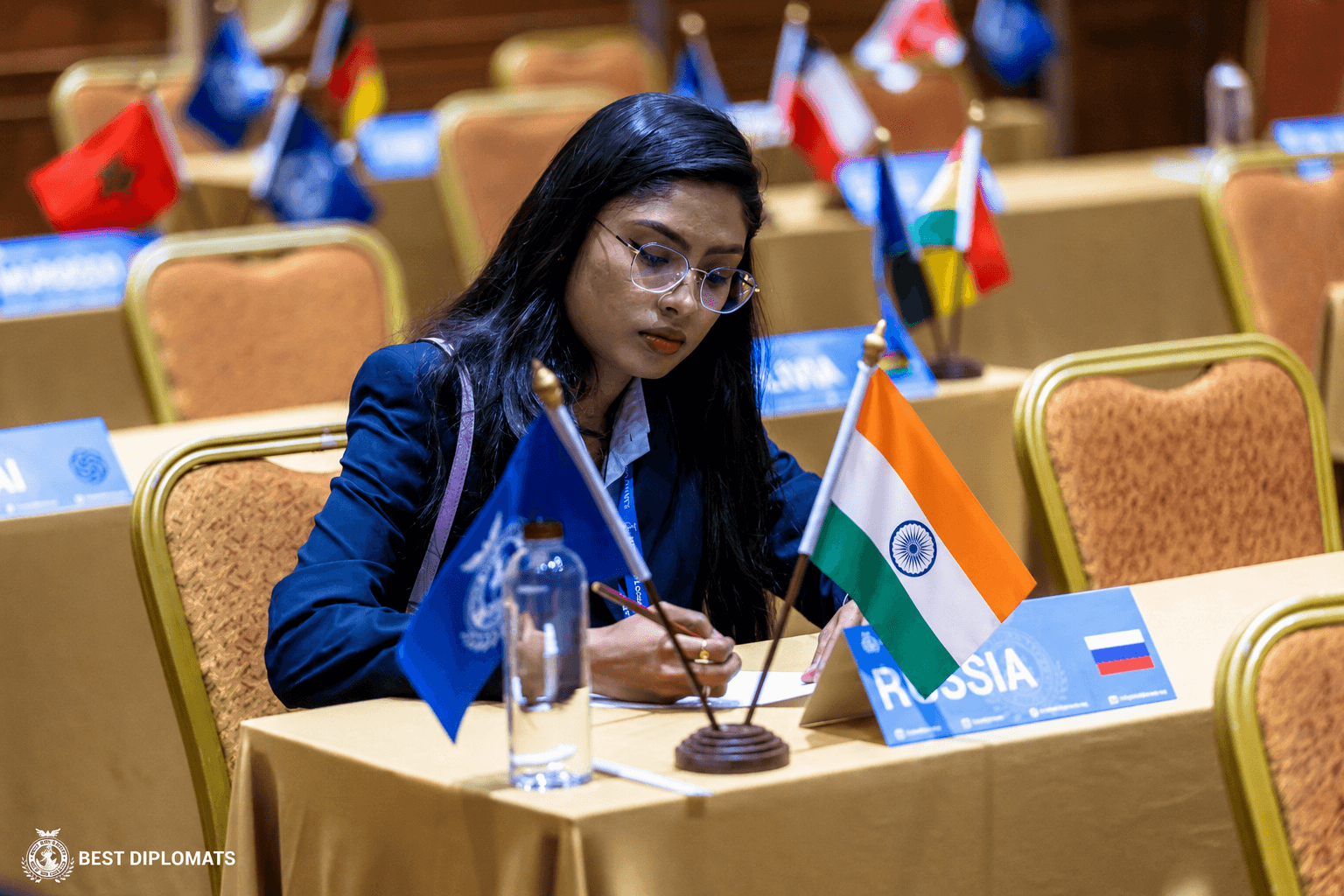
Meet the Founder A Journey of Curiosity, Service and Nation Building My name is Buddhisha Diksha Jaidev Randhave, and before introducing myself as the Founder of Youth of India Talks, I would like to introduce myself as a student—a student of life, of society, and of India. I was born in November 2000 and raised in Pune. My childhood taught me an important lesson very early: the opportunities we receive are not equally distributed. While I was fortunate to study in a good school, many children living only a few streets away never had access to the same learning environment. That contrast stayed with me and quietly shaped the purpose of my life. As a child, I never believed that education should remain confined to a classroom. When I was in the sixth standard, I approached the trustees of Gadge Maharaj School in Koregaon Park with a simple request—to allow me to teach children from nearby communities during my free time. They trusted me despite my age, and that trust changed my life. From the sixth to the ninth standard, I conducted summer camps where I taught spoken English, art, craft, creative activities, and the lessons I had learned in school. Those children may never realize it, but they became my first teachers. They showed me that knowledge gains its greatest value only when it is shared. As I grew older, my idea of service also grew. After learning karate, I began conducting free self-defence sessions for girls who could not afford formal training. Along with friends, I participated in cleanliness drives because I believed that responsible citizenship begins with taking responsibility for our own communities. These experiences also sparked another question in my mind: How does society really function? That curiosity led me towards governance, public administration, law, defence studies, history, economics, diplomacy and public policy. Every answer opened the door to another question, and learning became a lifelong habit rather than a phase of education. After completing my higher secondary education in science from Nowrosjee Wadia College, I joined the National Cadet Corps (NCC) with the hope of understanding discipline, defence and leadership while pursuing my Bachelor’s degree in Political Science. During my enrolment, I was asked to complete twenty-five rounds of the college ground as part of the selection process. I accepted the challenge without hesitation, not knowing that it would mark the beginning of one of the most transformative experiences of my life. NCC taught me far more than drills and uniforms. It taught me discipline, punctuality, resilience, teamwork and the importance of leading through action. I learned rifle shooting, boat pulling, semaphore communication, survival in demanding environments and the value of perseverance. Representing Maharashtra as the Best Cadet at the All India Nau Sainik Camp and earning recognition in multiple competitions were proud milestones, but the greatest achievement was the character that NCC helped me build. I later completed my NCC ‘C’ Certificate and also appeared for the Services Selection Board (SSB), where I gained valuable insights into leadership, self-awareness and continuous personal development. Alongside my education, I began working professionally at the age of eighteen. My corporate journey started as a Customer Service Representative with Concentrix, followed by experience in Amazon’s international operations and later in process training and operations at Cognizant. Balancing academics, employment, NCC, social work and self-development was challenging, but it taught me time management, professionalism and resilience. Beyond classrooms and workplaces, libraries became my second home. I spent long hours reading about India’s history, geography, governance, constitutional law, public administration, economics and public policy. I have always believed that informed opinions can only emerge from continuous learning, critical thinking and a willingness to question our own assumptions. My desire to understand the world also took me beyond India’s borders. In 2023, I participated in my first international diplomatic simulation through Best Diplomats. Representing a country’s perspective within a diplomatic exercise challenged me to think strategically, negotiate respectfully and appreciate the complexity of international relations. The experience strengthened my interest in diplomacy and policy-making, and I was honoured to receive recognition for my performance. Later, I had the privilege of serving as a Country Representative for India with Best Diplomats, mentoring and guiding aspiring delegates interested in global diplomacy. My learning journey continued through Youth Parliament initiatives, national policy competitions and discussions on governance, where I explored practical solutions to challenges affecting society. Whether studying law, public administration or public policy, my focus has remained the same: understanding how institutions function and how informed citizens can contribute to strengthening democracy. Throughout these experiences, one realization became increasingly clear. India does not lack talented young people. It lacks accessible platforms where young minds from different backgrounds can come together to learn, debate respectfully, exchange ideas and transform discussions into meaningful action. That realization gave birth to Youth of India Talks. Youth of India Talks is not simply a website. It is a community built on the belief that meaningful conversations can inspire meaningful change. It is a platform where students, professionals, researchers, entrepreneurs, lawyers, public servants and citizens can engage in informed discussions on law, governance, public policy, social issues, diplomacy, entrepreneurship and nation-building. It encourages evidence-based dialogue, collaborative learning and constructive solutions rather than division. My vision is to create a space where young people are not just listeners but contributors—where ideas evolve into proposals, proposals evolve into policy recommendations, and every participant receives recognition for their contribution. I believe that when young people are equipped with knowledge, guided by integrity and united by purpose, they become one of the greatest forces for national development. Like many Indians from marginalized communities, I have experienced prejudice and discrimination. Those experiences never became reasons to stop; they became reasons to grow. They taught me that the strongest response to prejudice is excellence, the strongest answer to doubt is preparation, and the strongest form of leadership is service. I do not claim to have all the answers, and I never intend to. I remain, first and foremost, a student—committed to learning every day. Youth of India Talks was never created to build a following around one individual. It was created to build a generation of informed, responsible and compassionate young Indians who believe that change begins with knowledge, dialogue and action. If my journey has taught me anything, it is this: No matter where we come from, our circumstances do not define our future. Curiosity can become knowledge. Knowledge can become service. Service can become leadership. And leadership, when guided by integrity, has the power to transform communities and strengthen our nation. If you share that belief, then I welcome you to Youth of India Talks. Let us learn together, lead together and contribute together towards building a stronger, more informed and more united India.